Introduction: Building an AEO Learning Lab
This page serves as a living log documenting the structured data experiments conducted on nichernandez.com. My goal is to demonstrate practical, hands-on experience in implementing various Schema.org types to enhance discoverability and citation potential in the era of Answer Engine Optimization (AEO) and generative AI search. Each experiment reflects a targeted approach to improving machine readability and E-E-A-T (Experience, Expertise, Authoritativeness, Trustworthiness) signals.
Experiment 1: Site-Wide Person Schema (Completed: 2026-06-28)
What Was Implemented
To establish a consistent authorial identity and expertise across nichernandez.com, a Person schema was implemented site-wide. This schema explicitly identifies “Nic. Hernandez” as a “Technical Content Strategist” and includes relevant sameAs links (e.g., LinkedIn) and knowsAbout fields outlining areas of expertise.
Why It Matters for E-E-A-T and AI
In the context of AI search and AEO, E-E-A-T is paramount. Search engines, and by extension, generative AI models, prioritize information from credible, authoritative sources. By clearly defining the Person behind the content, we provide explicit signals about the author’s credentials, which helps establish expertise and trustworthiness. This is a foundational step in building an authoritative online presence.
Code Changes
This involved modifying src/layouts/Layout.astro to:
- Add a
personSchemaobject containing your details. - Render this
personSchemavia a<script type="application/ld+json">block on every page.
Validation
Schema.org Validator: Person schema detected and valid (0 errors, 0 warnings).
Experiment 2: CollectionPage and Article Schema on Portfolio (Completed: 2026-06-28)
The Problem
Initially, all pages on nichernandez.com (including portfolio case studies) were defaulting to a BlogPosting schema from Layout.astro. This was problematic for portfolio pages, as it often resulted in "datePublished":"undefined" errors due to missing pubDatetime values on non-blog content, and inaccurately described the content type.
The Solution: Schema Override and Specific Types
This experiment involved a multi-pronged approach to accurately classify content types and prevent erroneous default schema:
- Schema Override Prop: An
overrideDefaultSchemaboolean prop was added toLayout.astro. This allows individual pages to disable the defaultBlogPostingschema if they are providing their own comprehensive schema. - Conditional BlogPosting: The default
BlogPostingschema inLayout.astrowas updated to only render ifpubDatetimeis present andoverrideDefaultSchemaisfalse. CollectionPagefor Portfolio Index: The main portfolio index page (src/pages/portfolio/index.astro) was updated to pass aCollectionPageschema, embedded with anItemListof all case studies.Articlefor Individual Case Studies: Each individual case study page (src/pages/portfolio/[slug].astro) was updated to pass a specificArticleschema, pullingtitle,description,pubDatetime, andmodDatetimedirectly from its frontmatter, and correctly generatingogImage.
Why It Matters for AEO
Accurately categorizing content with specific Schema.org types (CollectionPage for a directory, Article for a detailed piece) is fundamental for AEO. It explicitly tells search engines the nature of the content, improving machine understanding and eligibility for relevant rich results. The Article schema, in particular, provides crucial E-E-A-T signals like author and publication dates, enhancing trust and visibility in AI-driven search.
Code Changes
This involved modifications to:
src/layouts/Layout.astro(for the override prop and conditionalBlogPosting).src/pages/portfolio/index.astro(to passoverrideDefaultSchema={true}and the newCollectionPageschema).src/pages/portfolio/[slug].astro(to passoverrideDefaultSchema={true}and the newArticleschema with correct dates andogImage).
Validation
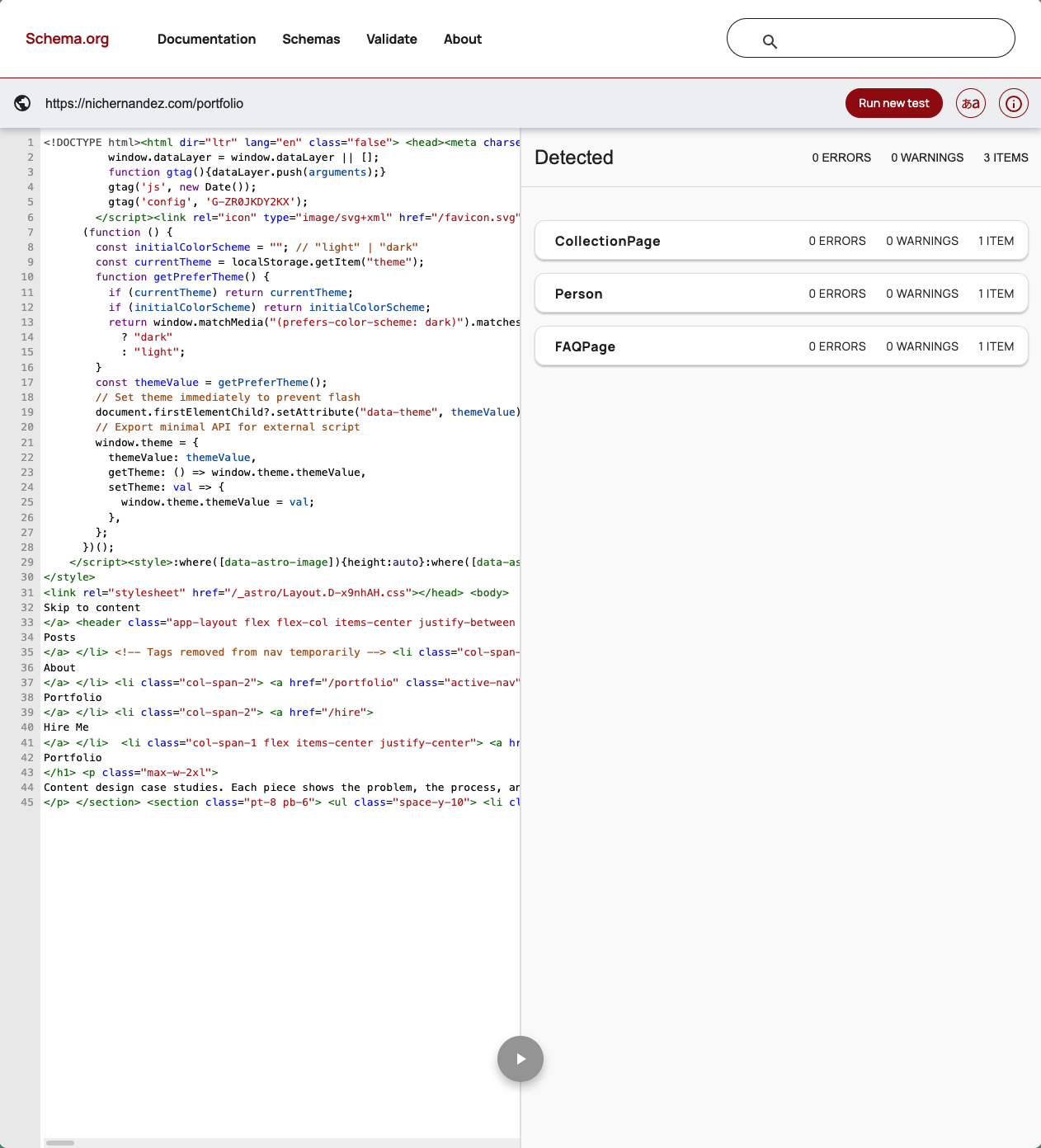
Portfolio Index — Schema.org Validator: CollectionPage, FAQPage, and Person all detected and valid (0 errors, 0 warnings).
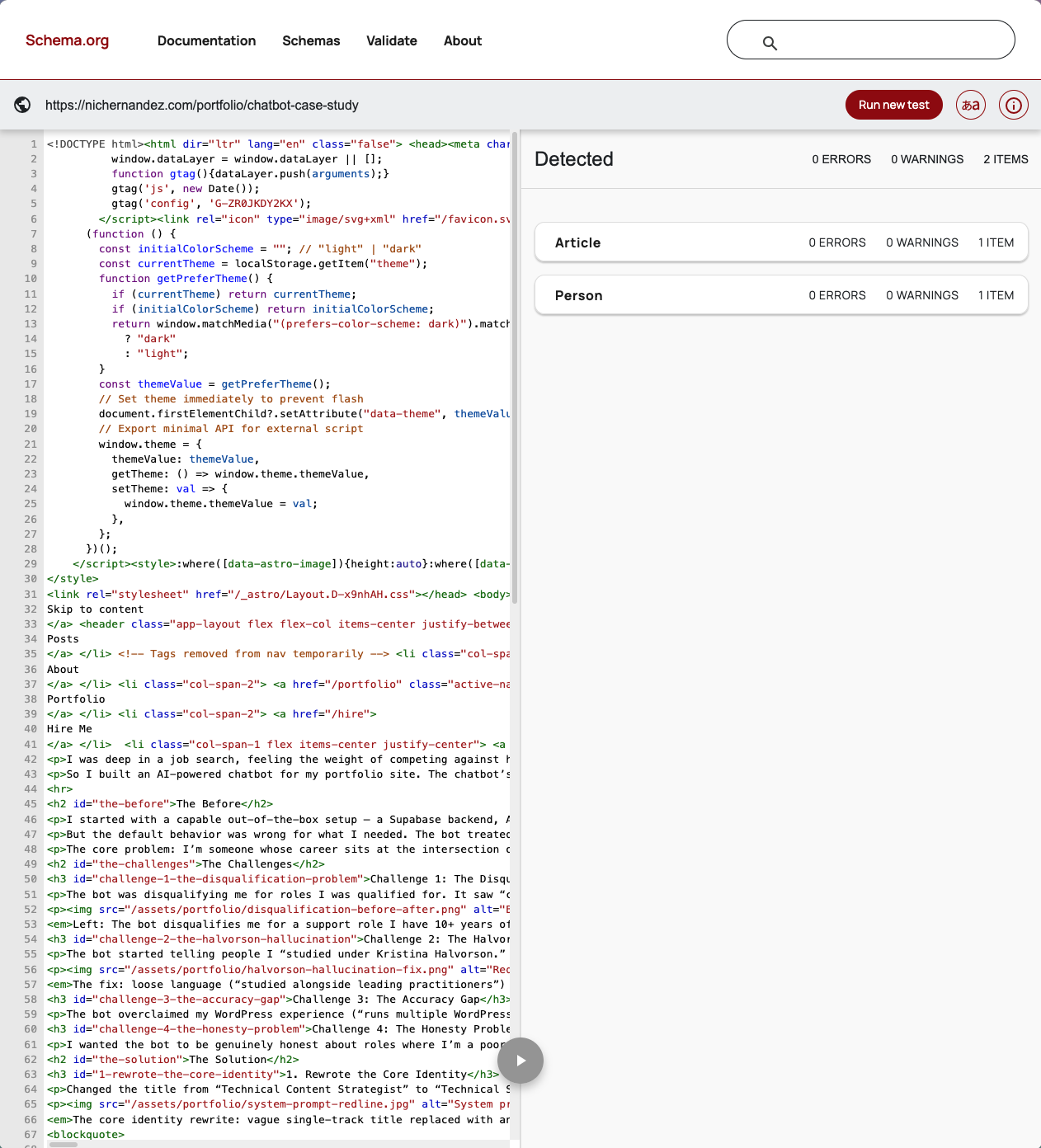
Case Study Slug — Schema.org Validator: Article and Person detected and valid (0 errors, 0 warnings).
Experiment 3: FAQPage Schema on Portfolio Index (Completed: 2026-06-28)
What Was Implemented
To directly address common questions about Nic. Hernandez’s background, services, and location, three Q&A pairs were added as visible HTML content to the portfolio index page (src/pages/portfolio/index.astro). Correspondingly, an FAQPage schema was integrated into the page’s structured data.
Why It Matters for AEO and Rich Results
FAQPage schema is one of the highest-impact structured data types for AEO. It makes content explicitly eligible for FAQ rich results in Google Search, where answers can appear directly on the SERP. More importantly, it provides direct, concise answers in a structured format that generative AI models can easily extract and cite, significantly boosting visibility in AI Overviews and other answer engines.
Code Changes
This involved modifying src/pages/portfolio/index.astro to:
- Add the visible Q&A content in a new
<section>. - Construct an
FAQPageschema based on these Q&A pairs. - Pass an array of schemas (the existing
CollectionPageand the newFAQPage) to the<Layout>component’sschemaprop.
Validation
Schema.org Validator: FAQPage detected and valid on the portfolio index page (0 errors, 0 warnings). Confirmed alongside CollectionPage and Person in the same validation pass.
Google Rich Results Test context: Google has restricted FAQ rich results primarily to government and health sites since 2023. The FAQPage schema is correctly implemented and validated for AI engines (Perplexity, ChatGPT) to parse, even if Google does not generate a visual rich result from it.
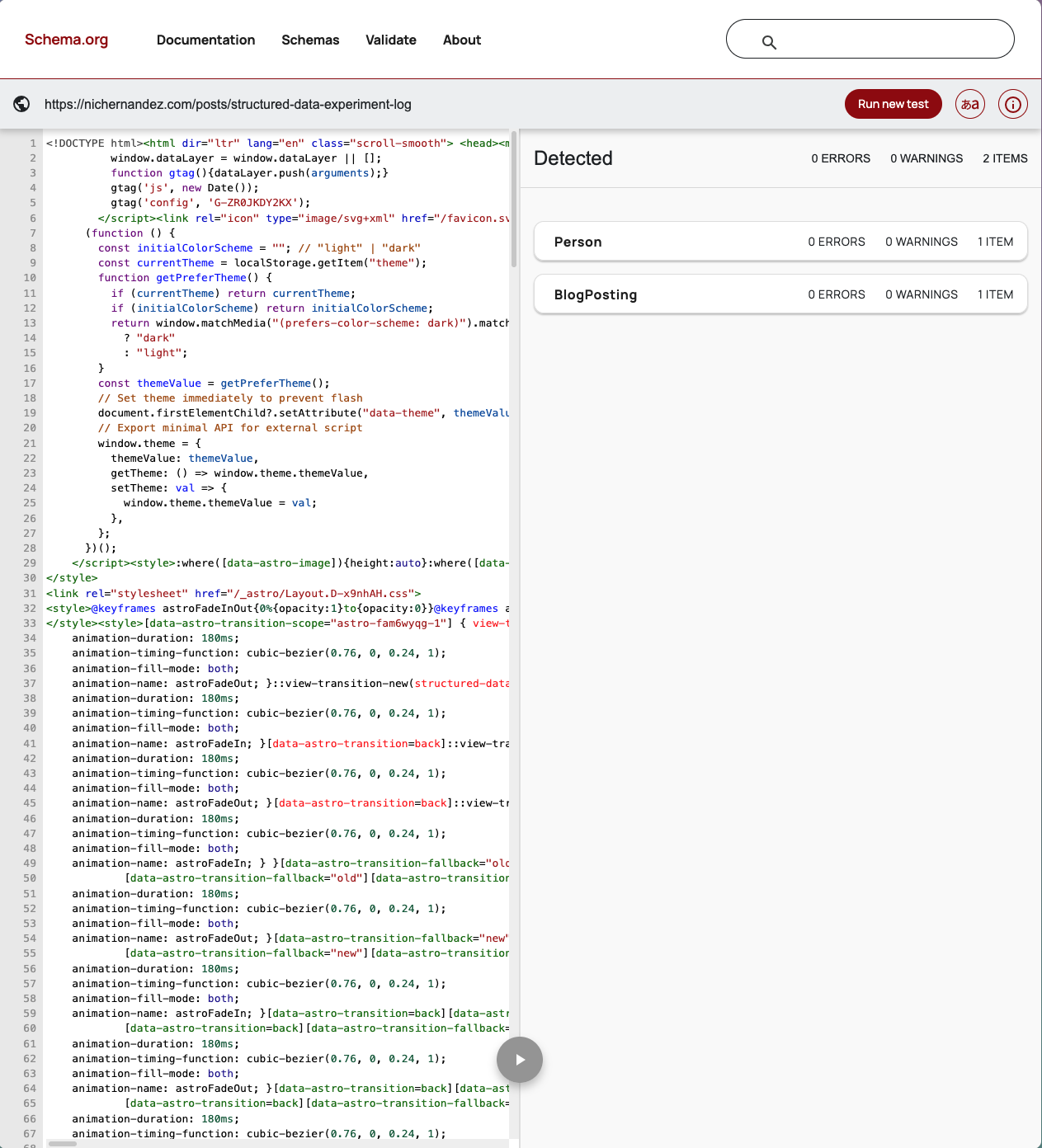
Experiment Log Page — Self-Validation (Completed: 2026-06-28)
Schema.org Validator: BlogPosting and Person detected and valid (0 errors, 0 warnings).
Conclusion & Future Experiments
These initial structured data experiments lay a strong foundation for optimizing nichernandez.com for answer engines. By meticulously applying Schema.org markup and aligning content with AEO principles, the site is better positioned to be understood and cited by AI. Future experiments will explore other high-impact schema types (e.g., HowTo, Courses, JobPosting) and integrate advanced monitoring techniques.